

In the United States, self-storage has become essential infrastructure for household moves, personal item storage, and small business inventory management. Whether a tenant is protecting personal belongings or an operator is reducing facility risk, choosing the right lock is the first line of defense.
Many first-time U.S. self-storage customers instinctively buy a standard long-shackle padlock from a hardware store, only to find out at move-in that it does not meet security requirements. So, what types of locks are commonly used across the U.S. self-storage industry?
1. The 3 Main Lock Types Used in U.S. Self-Storage
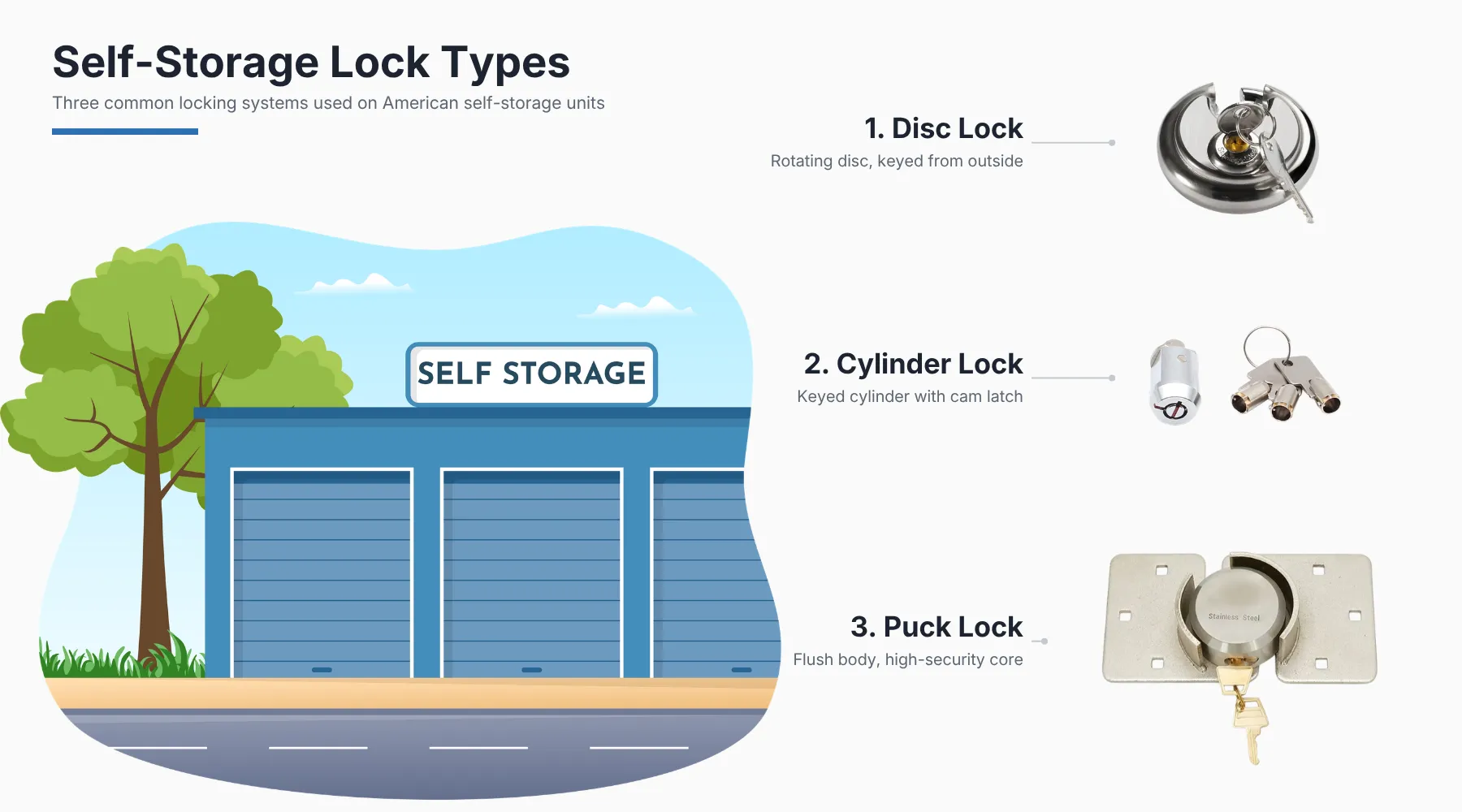
Self-storage roll-up doors or swing doors typically feature specialized latch mechanisms. To prevent thieves from using bolt cutters or pry bars, the industry primarily relies on three types of heavy-duty locks:
1. Disc Locks — The Industry Standard
Disc locks are the most common and widely adopted locks in U.S. self-storage, with most major chain facilities selling them directly at the front desk.
Design & Structure: The lock body is round and disc-shaped, typically encased in stainless steel. Its core design features a shrouded, short shackle—most of the shackle is enclosed inside a thick metal housing, leaving only a small opening to engage the latch.
Security Advantages: Because the shackle has minimal exposure, the jaws of large bolt cutters cannot easily get a grip, significantly reducing the risk of being cut by force.
Best For: Most roll-up door storage units with standard latch holes.
2. Cylinder Locks — Standard for Modern & Upscale Facilities
As modern self-storage facilities upgrade, more newly built or renovated properties use recessed latch systems (bezel latches) that require cylinder locks.
Design & Structure: Instead of a traditional external metal loop or shackle, the lock is a solid cylinder that fits directly into a dedicated slot in the latch assembly, locking the mechanism from within.
Security Advantages: Sitting nearly flush with the door hardware, the lock offers virtually no external leverage points, helping resist cutting, prying, and drilling.
Best For: Modern climate-controlled indoor units and upscale storage facilities with compatible latches.
3. Hidden Shackle / Puck Locks
Resembling a hockey puck, these locks are commonly seen on commercial trucks, shipping containers, and certain heavy-duty outdoor storage units.
Design & Structure: Featuring a thick, solid steel or aluminum alloy body, the shackle is completely recessed inside a channel at the back of the lock rather than visible from the front.
Security Advantages: They provide strong resistance against impact, prying, and cutting, and are typically paired with dedicated heavy-duty hasps.
2. Why Standard Padlocks Often Don’t Work in Self-Storage
Many storage operators explicitly prohibit standard long-shackle padlocks (or inexpensive cable combination locks) in their rental agreements for three main reasons:
Insufficient Security Rating: Standard padlocks have thin, fully exposed shackles that can be cut in seconds with basic tools, creating theft risks and insurance claim complications.
Latch Clearance & Fit: Self-storage roll-up door latches are compact. A standard padlock’s shackle may be too thick or too long to fit properly, or leave too much play once locked, making it easier to pry.
Weather Resistance: Many U.S. drive-up storage units are outdoors and exposed year-round to sun, rain, and temperature swings. Standard iron padlocks easily rust and seize, whereas stainless steel disc locks or corrosion-resistant models greatly reduce forced lock removal caused by rust.
3. Buying and Usage Tips
Verify Latch Dimensions in Advance: Latch hole sizes and thicknesses vary slightly across facilities (common disc locks are often around 70mm in diameter), so it is best to confirm compatibility with facility staff before buying.
Prioritize Rust-Resistant Materials: If you rent an outdoor drive-up unit, choose full stainless steel construction or models with weather-protective covers.
Keep Spare Keys Safe: Self-storage facilities generally follow a “tenant-controlled key” policy and do not keep spare keys for tenants’ locks. If all keys are lost, you typically need a licensed locksmith or staff with specialized cutting tools to remove the lock, which usually comes with a service fee.
Disclaimer: This article is intended to provide general, objective information on common hardware configurations and security practices in the U.S. self-storage industry. Specific security requirements depend on the policies of your chosen storage provider.