

🔒 Enhancing Padlock Security: How to Significantly Reduce the Interchangeability Rate Through Design and Specification Selection
As a padlock sales professional, I’m often asked by clients how to evaluate the “security” of a padlock. Beyond the obvious factors like material and construction, the Interchangeability Rate is a core technical metric – it measures the probability that different locks can be abnormally opened by the same key. Today, let’s start with the physical specifications of padlocks, delve into their relationship with the interchangeability rate, and share targeted solutions.
📊 Specifications and Security: Understanding the “Physical Code” of a Padlock
The security of a padlock doesn’t come out of thin air; its core secret lies in the pin tumbler structure of the lock cylinder and the combination of key cuts. Simply put:
- The smaller the lock body size, the more limited its internal space, which usually allows for fewer pin tumblers.
- The fewer the pin tumblers, the fewer variations of key cuts (i.e., the combination of biting depths) are possible, leading to a smaller key code capacity.
- A small key code capacity means different locks might share the same pin height combinations, allowing them to be opened by the same key or a small number of keys, resulting in a higher interchangeability rate.
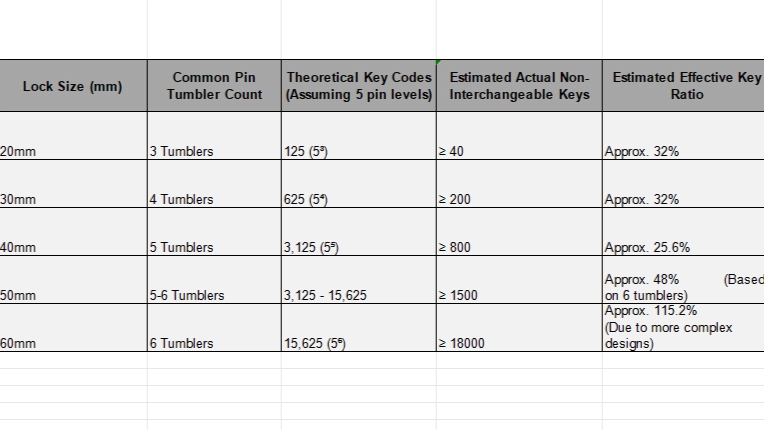
According to industry standards (like QB 1918-93) and common manufacturing practices, the typical number of pin tumblers, theoretical key code possibilities, and the estimated number of effectively non-interchangeable keys for different padlock sizes are summarized in the table above. It’s important to note that during actual production, some insecure or easily duplicated key combinations are eliminated, so the actual effective number of key codes is lower than the theoretical maximum